FBI International Cast Member Leaving: What It Means and How It Relates to the Volume of a Trapezoidal Prism
When news circulates that an FBI international cast member is leaving, the headline grabs attention, but the story often drifts into speculation. For readers who prefer concrete facts over rumors, the situation provides a chance to explore a completely different kind of precision: calculating the volume of a trapezoidal prism, a shape that appears in everything from architectural models to shipping containers.
Why a Sudden Departure Sparks Curiosity
In the world of television production, a cast change can reshape story arcs, affect audience expectations, and even alter a show's budget. The same principle of change applies to engineering and design, where substituting one dimension for another can dramatically affect a structure’s capacity. Understanding that shift requires a clear formula—just as the departure of a cast member demands a clear plan for the series.
Geometry in Action: The Trapezoidal Prism Explained
A trapezoidal prism is formed by extending a trapezoid along a third dimension. Its volume depends on three measurements: the areas of the two parallel faces (the bases) and the length of the prism. The general formula is:
Volume = (A₁ + A₂) / 2 × h
where A₁ and A₂ are the areas of the two trapezoidal ends, and h is the height (or length) of the prism. If the bases share the same shape, the equation simplifies to the average area multiplied by the height.
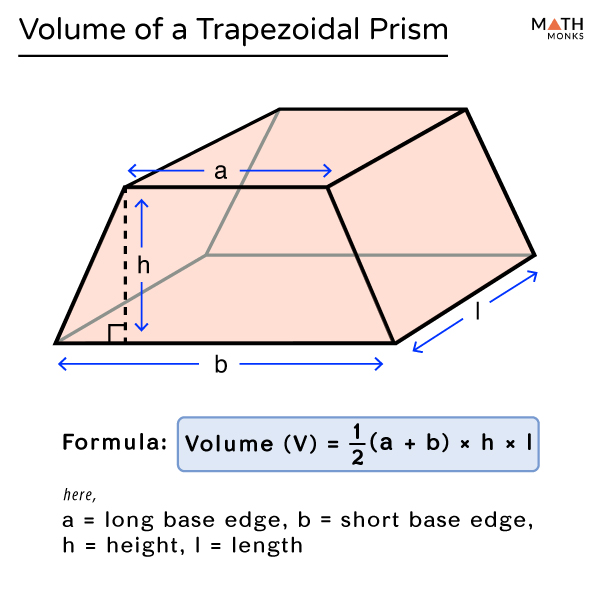
Step‑by‑step Example
- Measure the lengths of the two parallel sides of one trapezoidal base (let’s call them a and b).
- Find the height of that trapezoid (the perpendicular distance between a and b), label it d.
- Calculate the area of the first base: A₁ = (a + b) × d / 2.
- Repeat the process for the opposite base to get A₂.
- Measure the prism’s length h (the distance the trapezoid is extruded).
- Apply the volume formula: V = (A₁ + A₂) / 2 × h.
For a practical illustration, imagine a museum exhibit that uses a trapezoidal glass case to display artifacts. If each base measures 2 m × 1 m with a height of 0.5 m, and the case extends 3 m outward, the volume works out to roughly 4.5 m³, enough space to store a modest collection.
Real‑World Implications of Accurate Volume Calculations
Just as a production team must recalibrate storylines after a cast member leaves, engineers must adjust material orders and load calculations when a design’s dimensions change. Misjudging the volume of a trapezoidal prism can lead to over‑ or under‑estimating material costs, shipping fees, or structural load. In industries like construction, accurate volume assessments prevent costly rework and ensure safety standards are met.
Choosing the Right Approach for Your Project
When deciding whether to model a component as a simple rectangular prism or a more nuanced trapezoidal prism, consider the following criteria:
- Shape fidelity: If the object tapers or widens, a trapezoidal model captures that nuance.
- Material efficiency: Precise volume calculations reduce waste by ordering exactly the needed amount of concrete, resin, or fabric.
- Load distribution: Engineers often need to know the exact internal space to predict how weight will be spread across supports.
- Cost impact: Even a 5 % error in volume can translate into thousands of dollars when dealing with bulk materials.
Bottom Line
The headline about an FBI international cast member leaving may dominate the news cycle, but the underlying lesson is clear: change demands clarity. Whether you’re rewriting a television script or redesigning a trapezoidal prism, a solid formula provides the footing you need to move forward confidently. By mastering the volume calculation, professionals across fields can avoid unnecessary surprises and keep their projects on track.