How to Star Citizen Buy Ship Weapons: A Step‑by‑Step Comparison Guide
Getting the right armament for your spacecraft in Star Citizen can feel like a science experiment—choose the right reaction, control the output, and watch the impact. This guide walks detail‑oriented researchers through the practical steps of buying ship weapons, comparing in‑game options, and highlighting the trade‑offs that affect combat performance.
Understanding the Weapon Marketplace
The in‑game store, the Refined Refineries market, and third‑party retailers each list weapons with distinct pricing models, lock‑in periods, and upgrade paths. Comparing these sources side by side reveals where you can stretch credits the furthest. For example, a standard Gimballed Pulse Laser bought directly from the in‑game store typically carries a higher upfront cost than the same model listed on the Refined Refineries market, which often offers a 5‑10 % discount for bulk purchases.
Step‑by‑Step Purchase Process
- Identify your ship’s hardpoints. Each vessel—whether it’s the versatile Aurora or the heavy‑duty Avenger—has a fixed number of hardpoints and power budgets. Check the ship’s spec sheet to see how many kinetic, energy, or missile slots are available.
- Match weapon class to combat role. Energy weapons (e.g., Pulse Lasers) excel at sustained fire, while kinetic weapons (e.g., Autocannons) deliver burst damage. Missile launchers add long‑range punch but consume ammunition.
- Compare prices across vendors. Open the market UI, filter by weapon type, and note the credit price, any bundle discounts, and the vendor’s reputation score.
- Review upgrade compatibility. Some weapons support barrel upgrades, cooling modules, or ammo types. Verify that the upgrades you plan to add are listed under the same vendor to avoid cross‑vendor conflicts.
- Finalize the transaction. Add the desired weapon to your cart, confirm the total credit cost, and complete the purchase. The item appears in your inventory, ready for installation via the ship loadout screen.
Practical Comparisons: Energy vs. Kinetic vs. Missile
When weighing options, think of the three categories as different scientific processes. Energy weapons resemble the controlled release of nuclear fission—steady, high‑energy output that can be modulated. Kinetic weapons are more like conventional explosives, delivering raw impact. Missile systems act as guided projectiles, akin to particle beams that travel farther before detonating.
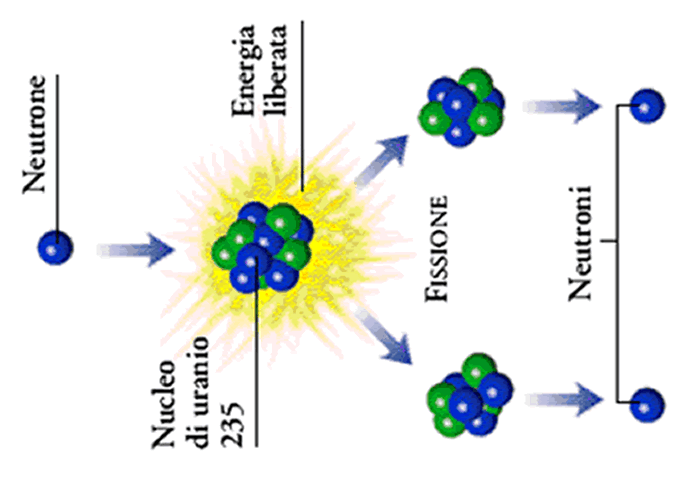
The diagram above, originally showing nuclear fission, serves as a visual metaphor for how an energy weapon’s power cells discharge in a controlled cascade, mirroring the way a pulse laser delivers consistent damage over time.
Implications for Gameplay and Strategy
Choosing the right weapon mix directly influences sortie success rates. A ship fitted with a balanced combo—two pulse lasers for dogfighting, one missile launcher for long‑range strikes—offers flexibility across mission types. Conversely, a single‑weapon focus can excel in specialized roles, such as bounty hunting or mining defense, but may struggle in unexpected engagements.
Another strategic layer is the resale value. Weapons purchased during promotional periods often retain higher resale percentages, providing a credit buffer for future upgrades. Tracking market trends through the in‑game analytics tab helps you spot when a weapon’s price peaks, allowing you to buy low and sell high.
Final Checklist Before You Click “Buy”
- Confirm hardpoint availability and power draw limits.
- Cross‑reference prices on at least two market sources.
- Ensure upgrade paths are compatible with your existing loadout.
- Consider future resale potential based on current market trends.
- Validate that the weapon aligns with your intended combat role.
By treating the purchase of ship weapons as a structured comparison exercise, you turn a routine transaction into a tactical advantage. Follow the steps above, stay mindful of market fluctuations, and your Star Citizen fleet will be armed for any scenario the universe throws at you.